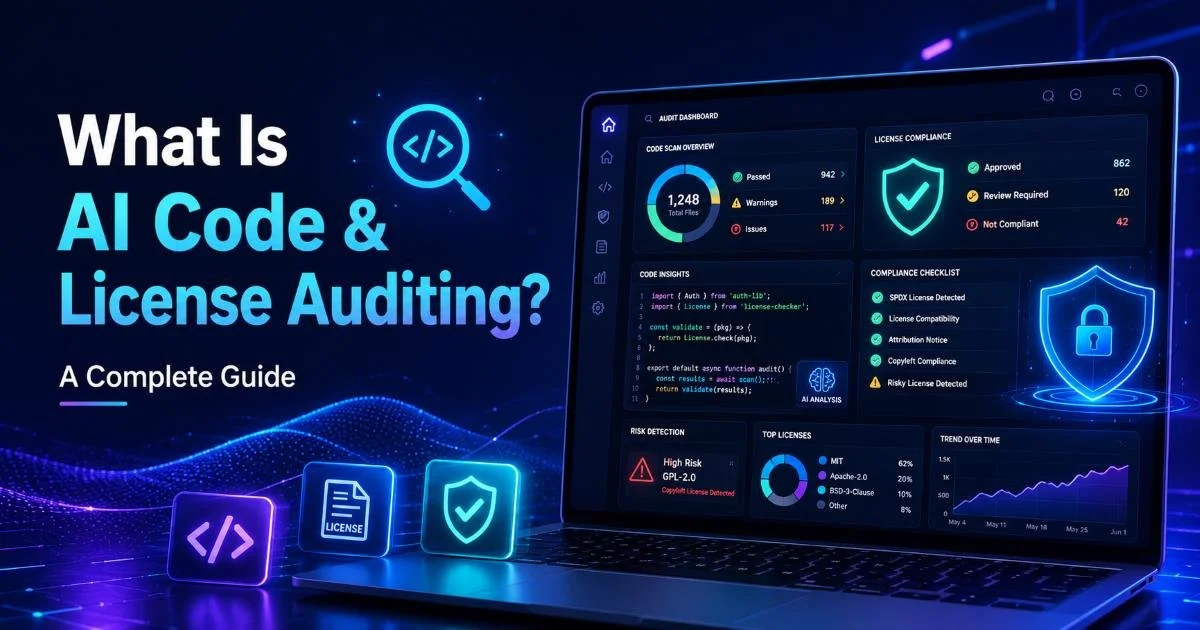
An AI code license audit is the automated process of scanning a software codebase and its dependencies using artificial intelligence to detect licensing conflicts, compliance gaps, and legal risks before they become costly problems. For software developers and engineering leads, understanding this practice is no longer optional.
The average modern application pulls in hundreds of open source packages, each carrying its own license terms. A single overlooked copyleft obligation can force you to release proprietary code or face litigation. Traditional manual reviews simply cannot keep pace with the speed of modern development pipelines.
AI-powered auditing addresses this gap by combining static analysis, natural language processing, and pattern recognition to flag issues in minutes rather than weeks. The stakes are real: license violations have led to injunctions, product recalls, and multimillion-dollar settlements across the software industry.
Key Takeaways
- AI code license audits automatically scan dependencies and flag licensing conflicts at scale.
- Open source compliance failures can result in forced code disclosure or legal action.
- Modern applications average over 500 open source dependencies, making manual review impractical.
- AI models identify license text variants that keyword-based scanners frequently miss.
- Integrating audit tools into CI/CD pipelines catches risks before code ships to production.
How AI Code License Audits Work
Dependency Discovery and SBOM Generation
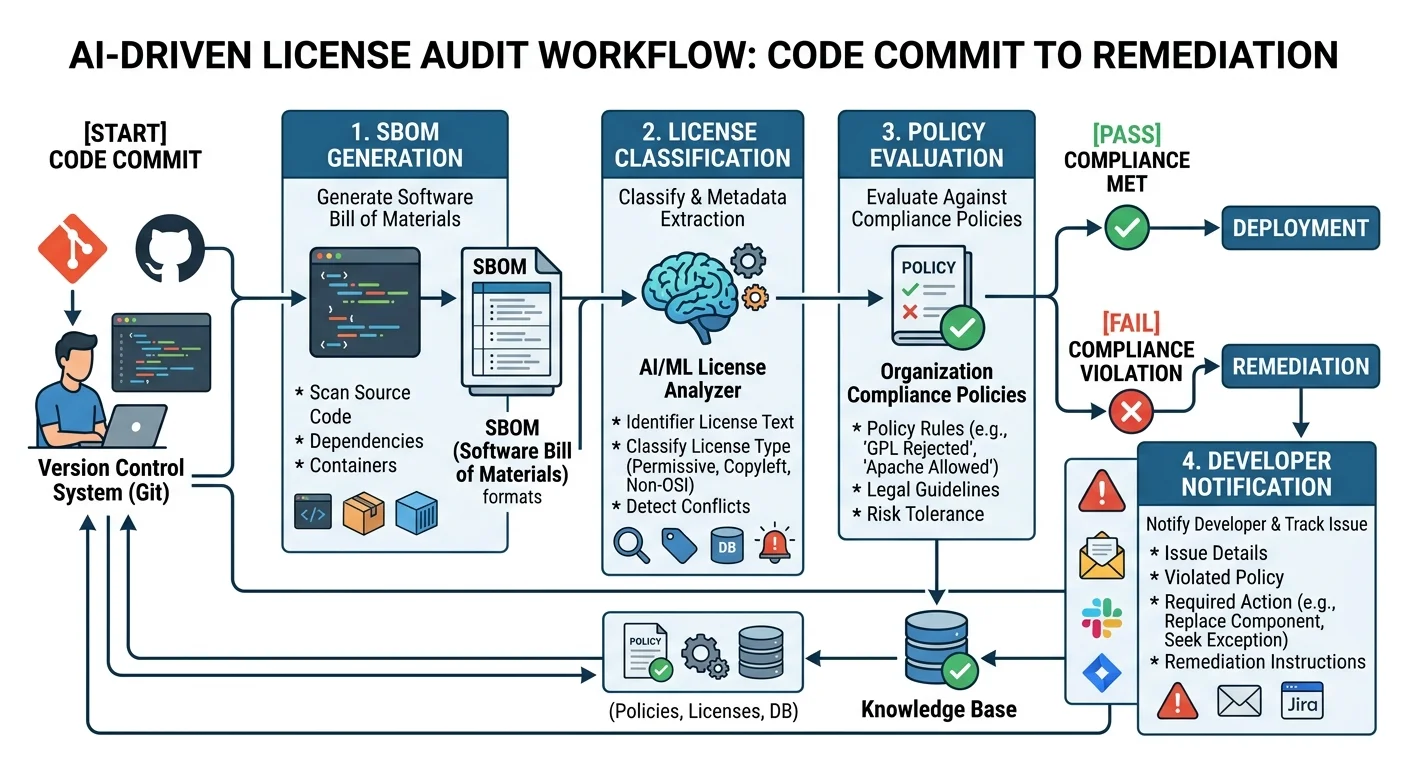
The process begins with a complete inventory of your software's components. An AI code license audit tool traverses your project's manifest files (package.json, pom.xml, requirements.txt, go.mod) and resolves the full transitive dependency tree. This means it doesn't just look at packages you explicitly imported; it maps every sub-dependency those packages pull in. The output is a Software Bill of Materials (SBOM) that catalogs every component, its version, and its declared license.
Generating an SBOM manually for a mid-sized application with 800 dependencies would take an engineer days. Automated tools accomplish this in seconds. The SBOM serves as the foundation for all subsequent analysis, giving auditors and AI models a structured dataset to work with. Without this complete picture, any compliance check operates on incomplete information and will inevitably miss risks buried in nested dependencies.
License Classification with AI
Once the SBOM exists, AI models classify the license associated with each component. This goes beyond simple string matching. Many open source projects use modified license texts, custom headers, or dual-licensing schemes that confuse traditional scanners.
Natural language processing models trained on thousands of license variants can recognize that a modified BSD clause still carries BSD obligations, even when the exact wording differs from the SPDX standard template.
The AI then cross-references detected licenses against your project's declared license and your organization's policy. A permissive MIT-licensed application pulling in a GPL-3.0 library, for example, triggers an immediate compatibility warning. Advanced tools also analyze code snippets for copy-pasted segments from differently licensed projects, a risk that file-level scanning alone cannot catch. This depth of analysis is what separates modern AI-driven approaches from older dependency audit methods that relied purely on metadata.
Configure your license compliance tool to run on every pull request, not just periodic scans, to catch issues at the point of introduction.
Why AI Code License Audits Matter
Open source compliance has shifted from a best practice to a business requirement. Enterprises acquiring software companies now routinely demand clean license audits as part of due diligence. The European Union's AI Act and related frameworks, including the EU Code of Practice for General-Purpose AI, are establishing expectations around transparency in software composition. Organizations that cannot demonstrate they understand what's in their software face regulatory and commercial headwinds that will only intensify.
Software license risks extend beyond legal liability. Engineering teams that discover a GPL violation late in a product cycle face painful choices: rip out and replace the offending component, open-source their proprietary code, or negotiate a commercial license from the original author. Each option costs time and money. An AI code license audit catches these conflicts when a developer first adds the dependency, turning a potential crisis into a two-minute fix.
"The cheapest time to fix a license conflict is the moment a developer adds the dependency, not the week before a product launch."
Real-World Compliance Consequences
History provides plenty of warnings. The Free Software Foundation has pursued enforcement actions against companies violating GPL terms. Cisco's subsidiary Linksys settled a high-profile GPL case that required them to release router firmware source code. More recently, the Software Freedom Conservancy has actively pursued compliance cases against consumer electronics manufacturers. These are not theoretical risks; they are documented outcomes that affected real products and real revenue.
Beyond enforcement, M&A transactions have collapsed or been renegotiated because of license contamination discovered during due diligence. A 2023 report found that 31% of audited codebases contained components with no identifiable license at all, creating unknown risk profiles that acquirers refuse to accept. For engineering leads, running a dependency audit before any major business milestone is simply good hygiene.
| License | Type | Requires Source Disclosure | Compatible with Proprietary Code | Patent Grant |
|---|---|---|---|---|
| MIT | Permissive | No | Yes | No |
| Apache 2.0 | Permissive | No | Yes | Yes |
| GPL 3.0 | Copyleft | Yes | No | Yes |
| LGPL 2.1 | Weak Copyleft | For library modifications | Yes (with linking) | No |
| BSD 2-Clause | Permissive | No | Yes | No |
| AGPL 3.0 | Strong Copyleft | Yes (including network use) | No | Yes |
AGPL-licensed components trigger source disclosure obligations even for server-side software that is never distributed. Many teams overlook this distinction.
Common Misconceptions About AI License Auditing
Myth vs. Reality
One widespread misconception is that AI code review and AI license auditing are the same thing. They are not. AI code review focuses on code quality, bugs, security vulnerabilities, and style consistency. AI license auditing focuses specifically on the legal and compliance dimensions of the components in your software.
Some platforms bundle both capabilities, but they address fundamentally different risk categories. Conflating them leads to blind spots where teams believe they are covered when they are only addressing half the picture.
Another myth is that permissive licenses like MIT mean "do whatever you want." Even MIT requires you to include the original copyright notice and license text in your distribution. Failing to do so is technically a violation.
Teams often strip license files during build processes without realizing they're creating compliance issues. A good license compliance tool flags these omissions automatically, catching problems that developers often consider trivial but that lawyers take seriously.
Some developers also assume that internal-only tools don't need license audits. This is incorrect for several reasons. Many licenses (particularly AGPL) have provisions that trigger obligations when software is accessed over a network, even if it is never formally "distributed." Additionally, internal tools have a way of becoming external products. What starts as a team utility today may be packaged and sold next year, and retroactively cleaning up license debt is far harder than preventing it.
Even if your software is never publicly released, license obligations may still apply depending on how the software is accessed and by whom.
Finally, there is a belief that running one audit is sufficient. Software dependencies change with every update. A clean audit in January means very little by June if your team has added dozens of new packages. Continuous monitoring, ideally integrated into your CI/CD pipeline, is the only approach that maintains compliance over time. Teams using AI agent monitoring solutions for their operational infrastructure should apply the same continuous oversight philosophy to their license compliance posture.
Related Concepts and How They Connect
AI Code Review vs. License Audit
AI code review tools like those built into GitHub Copilot or Amazon CodeWhisperer analyze your source code for quality and correctness. An AI code license audit tool operates on a different axis entirely, examining not what your code does but what legal obligations it carries.
The best engineering workflows incorporate both. Run ai code review on your own code for bugs and vulnerabilities; run a license audit on your full dependency graph for compliance. Treating these as complementary rather than interchangeable produces genuinely comprehensive risk coverage.
Software Composition Analysis (SCA) is the broader category that encompasses license auditing, vulnerability scanning, and dependency mapping. Many SCA platforms now incorporate AI to improve accuracy across all three functions.
However, not all SCA tools give equal weight to license analysis. Some prioritize CVE detection and treat licensing as an afterthought, providing only basic SPDX matching. When evaluating tools, look specifically for NLP-based license classification, policy engine customization, and transitive dependency resolution as indicators of genuine depth.
Supply chain security is another adjacent concept gaining momentum after incidents like the Log4Shell vulnerability and the xz-utils backdoor. While supply chain security focuses on the integrity and trustworthiness of dependencies, license auditing focuses on their legal terms. Both start from the same SBOM.
Organizations that invest in generating accurate, up-to-date SBOMs get compounding returns: the same data feeds vulnerability scanning, license compliance checks, and supply chain provenance verification. This shared foundation makes the case for integrated tooling strong.
The AI code license audit space is evolving quickly. New regulations, growing open source adoption, and the proliferation of AI-generated code (which may carry ambiguous licensing) are raising the bar for what competent compliance looks like.
Engineering leads who build audit capabilities into their development workflows now will be far better positioned than those scrambling to retrofit compliance after a regulatory inquiry or acquisition due diligence request surfaces problems they never knew they had.
Frequently Asked Questions
?How do I integrate an AI license audit into my CI/CD pipeline?
?How does AI license classification differ from keyword-based scanners?
?How long does generating an SBOM for 800 dependencies actually take?
?Is it enough to only audit direct dependencies and skip transitive ones?
Final Thoughts
An AI code license audit is a practical, increasingly necessary component of modern software development. It protects your organization from legal exposure, streamlines compliance for audits and acquisitions, and gives engineering teams confidence that the open source components they rely on won't create unexpected obligations.
The tooling has matured to the point where integration is straightforward, and the cost of inaction far exceeds the cost of adoption. Start with your most critical projects, generate SBOMs, set license policies, and let AI handle the complexity of keeping your codebase clean.
Disclaimer: Portions of this content may have been generated using AI tools to enhance clarity and brevity. While reviewed by a human, independent verification is encouraged.