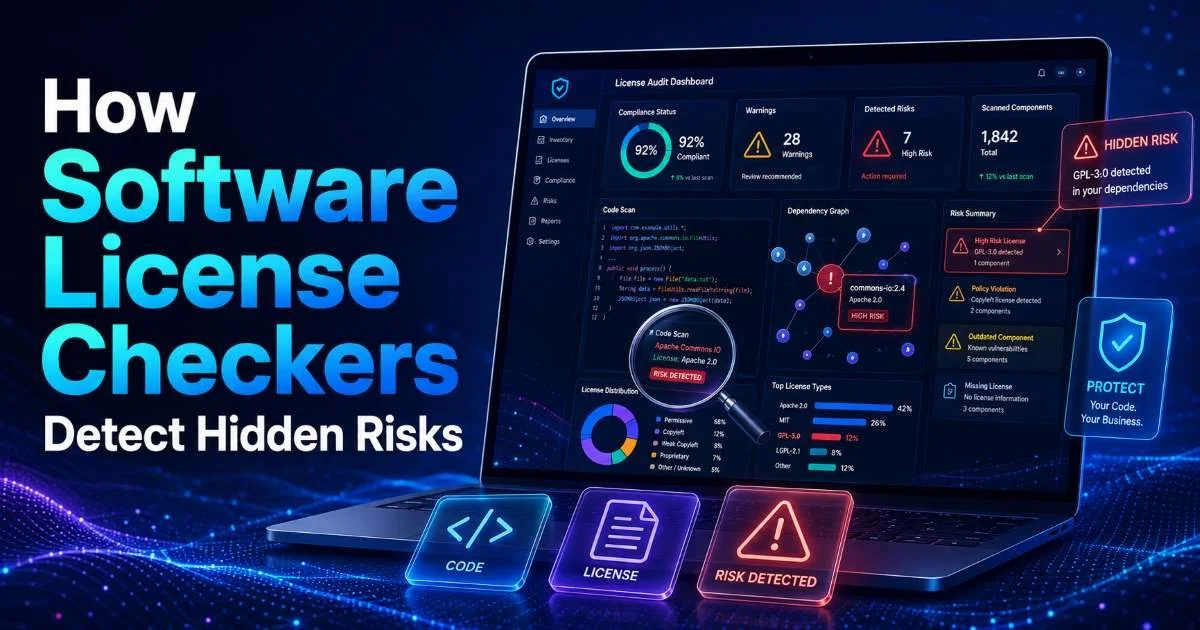
Software license checker tools have become a frontline defense for development teams managing complex dependency trees. Every modern application pulls in dozens, sometimes hundreds, of open source packages, and each one carries its own license terms. A single copyleft license buried three layers deep in your dependency graph can force disclosure of proprietary code or trigger costly legal disputes.
AI code audit capabilities now make it possible to scan entire repositories in minutes, flagging license risk detection issues that would take a human reviewer days to uncover. As the practice of AI-powered code license auditing matures, engineering teams need a clear process for putting these tools to work.
This guide walks you through the practical steps of detecting hidden license risks before they become business problems. Understanding how these systems operate gives you control over your software supply chain.
Key Takeaways
- Transitive dependencies carry the most dangerous hidden license risks in your codebase.
- Automated license checkers should run inside your CI/CD pipeline on every build.
- AI-powered scanners detect license conflicts that keyword-based tools consistently miss.
- Maintaining a curated license allowlist prevents unapproved packages from entering production code.
- Regular audits catch license drift caused by upstream dependency version changes over time.
1. Map Your Full Dependency Tree and Identify Exposure Points
Before any license checker can do its job, you need a complete picture of what your application actually contains. Most developers know their direct dependencies well enough, but the real risk lives in transitive dependencies: the packages your packages depend on. A typical Node.js project with 20 direct dependencies can easily pull in 800 or more transitive packages. Each of those carries license obligations that flow upstream to your project.
Start by generating a Software Bill of Materials (SBOM) for every project. Tools like CycloneDX and SPDX produce standardized formats that license scanners can consume. Run npm ls --all, pip freeze, or mvn dependency:tree to get a raw view first, then convert that output into a structured SBOM. This inventory is your foundation; without it, any audit is incomplete.
Why Transitive Dependencies Matter Most
Consider a real scenario: your project uses a popular MIT-licensed HTTP client library. That library depends on a utility package licensed under LGPL-2.1, which in turn uses a small string-processing module under GPL-3.0. If your application statically links these components, the GPL-3.0 terms may apply to your entire binary. This cascading effect is exactly the type of hidden risk that manual review routinely misses.
Never assume a dependency's license matches its parent package. Always verify each level independently.
Mapping your full dependency tree also reveals "phantom" dependencies, packages that were once included but whose references linger in lock files or build caches. These orphan packages still expose you to license obligations even if their code never executes. Clean up stale references as part of every dependency mapping exercise, and pin versions explicitly to prevent unexpected license changes during updates.
2. Configure Your Software License Checker for Accurate Detection
A license checker is only as good as its configuration. Out of the box, most tools recognize common SPDX identifiers like MIT, Apache-2.0, and GPL-3.0. But real-world packages often use nonstandard license declarations, custom license text, or no declaration at all. Your tool needs rules to handle these edge cases, otherwise it will either flood you with false positives or silently miss genuine violations.
Setting Up License Allowlists and Blocklists
Create a license allowlist that reflects your organization's actual legal posture. Most commercial software teams approve MIT, BSD-2-Clause, BSD-3-Clause, Apache-2.0, and ISC without restriction. Copyleft licenses like GPL-3.0, AGPL-3.0, and SSPL typically go on the blocklist. Licenses in a gray area, such as MPL-2.0 or LGPL-2.1, deserve a separate review queue where legal counsel can evaluate them on a case-by-case basis.
| License | Category | Typical Policy | Key Obligation |
|---|---|---|---|
| MIT | Permissive | Allow | Attribution in notices |
| Apache-2.0 | Permissive | Allow | Attribution, patent grant |
| BSD-3-Clause | Permissive | Allow | Attribution, no endorsement |
| MPL-2.0 | Weak Copyleft | Review | File-level source disclosure |
| LGPL-2.1 | Weak Copyleft | Review | Dynamic linking preferred |
| GPL-3.0 | Strong Copyleft | Block | Full source disclosure |
| AGPL-3.0 | Network Copyleft | Block | Source disclosure over network |
Store your license policy as a YAML or JSON config file in your repository so it's version-controlled alongside your code.
Configure your checker to fail builds when blocklisted licenses appear, and to flag review-queue licenses as warnings. This graduated response prevents pipeline bottlenecks while still catching the most dangerous violations immediately. Document every policy decision with a brief rationale so future team members understand why certain licenses were categorized the way they were.
Read also SSL Certificate Checker vs Manual Verification Guide
Pay special attention to "NOASSERTION" and "NONE" entries in SBOM data. These indicate packages where the scanner could not determine a license at all. Treat unknown licenses as blocklisted by default. It is far safer to investigate a false alarm than to ship proprietary software tainted by an undisclosed copyleft obligation.
3. Integrate AI-Powered Scanning Into Your Workflow
Traditional license scanners rely on pattern matching against known license texts. They compare file contents to a database of templates and return the closest match. This approach works for well-formatted LICENSE files, but it struggles with license text embedded in source code comments, modified license wording, or dual-license declarations. AI-powered code audit tools address these gaps by understanding the semantic meaning of license language rather than just matching character sequences.
How AI Differs from Pattern Matching
Machine learning models trained on millions of license texts can identify license intent even when the exact wording has been paraphrased or combined with other terms. For example, some packages include a "modified BSD" license with custom clauses added by the author.
A pattern matcher might classify this as "Unknown" while an AI model recognizes the BSD foundation and flags the custom additions for human review. Selecting the best LLM for software development tasks like license analysis depends on the model's training data coverage and its ability to reason about legal text.
"The most dangerous license risks are the ones your tools classify as "Unknown" and your team ignores."
Integrate your AI scanner into the CI/CD pipeline so every pull request triggers an automatic open source compliance check. GitHub Actions, GitLab CI, and Jenkins all support adding a license scan step that runs after dependency installation but before testing. When the scanner finds a violation, it should post a comment directly on the pull request with the package name, detected license, and your policy's verdict. This gives the developer immediate, actionable feedback.
Do not rely on a single detection method. The chart above illustrates why layering multiple approaches catches more issues. AI semantic analysis finds violations that pattern matchers miss, but manual review still catches the most per package when applied.
The practical solution is to use automated tools for broad coverage and reserve human review for flagged items and high-risk components. This layered approach gives you the best balance of speed and accuracy for license risk detection across your entire portfolio.
AI scanning results should always be reviewed by a human before taking legal action. Models can misinterpret highly customized license texts.
4. Act on Findings and Build a Repeatable Compliance Process
Detecting license risks is only valuable if your team acts on the findings systematically. When a scan flags a problematic dependency, you need a clear decision tree. Can you replace the package with an alternatively licensed equivalent? Can you isolate it behind a dynamic linking boundary? Or does the business value justify accepting the license terms? Each option carries different costs and timelines, and someone needs to own the decision.
Remediation Strategies for Common Violations
The most straightforward fix is swapping out the offending package. If a GPL-3.0 image processing library triggered the alert, check whether a permissively licensed alternative offers comparable functionality. The npm, PyPI, and Maven ecosystems each have multiple options for most common tasks. Document the swap, including the reason, the alternative chosen, and the date, in a compliance log stored in your repository.
For cases where replacement is impractical, architectural isolation becomes the path forward. LGPL-licensed libraries can often be used in proprietary software if you link to them dynamically rather than statically. This means distributing the LGPL component as a separate shared library that users could theoretically replace. Verify your build system actually produces dynamic links; static linking can happen silently depending on your toolchain's defaults.
Schedule a quarterly license audit even if your CI/CD pipeline runs checks on every build. Upstream packages change licenses between versions more often than you'd expect.
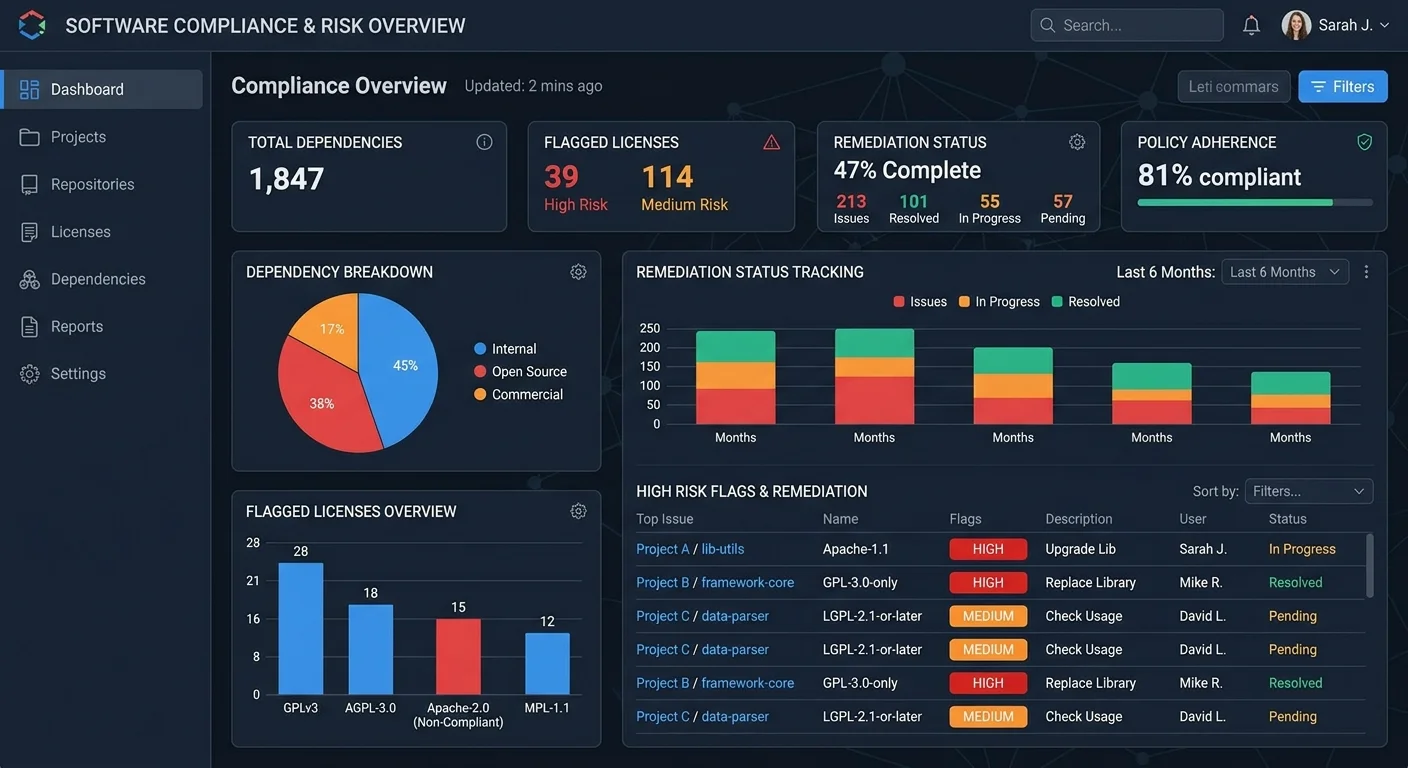
Build a compliance dashboard that tracks the total number of dependencies, the count of flagged items, the remediation status of each, and the trend over time.
This visibility matters not just for engineering leads but for anyone involved in M&A due diligence, customer security questionnaires, or regulatory compliance. A well-maintained compliance process turns software audit from a reactive fire drill into a routine part of your engineering culture. Track metrics monthly, assign ownership for unresolved findings, and celebrate when your unknown-license count reaches zero.
Frequently Asked Questions
?How do I add a license checker to my CI/CD pipeline?
?How does AI scanning differ from keyword-based license detection?
?How long does auditing a large repo with transitive deps actually take?
?Can a GPL-3.0 transitive dependency affect code I never directly call?
Final Thoughts
Hidden license risks do not announce themselves, and they compound as your dependency tree grows. The combination of thorough dependency mapping, well-configured license checkers, AI-powered semantic analysis, and a disciplined remediation process gives your team real protection.
Start with the SBOM, automate your scans, and treat every unknown license as a potential problem until proven otherwise. The teams that build compliance into their daily workflow spend far less time scrambling when auditors or acquirers come knocking.
Disclaimer: Portions of this content may have been generated using AI tools to enhance clarity and brevity. While reviewed by a human, independent verification is encouraged.