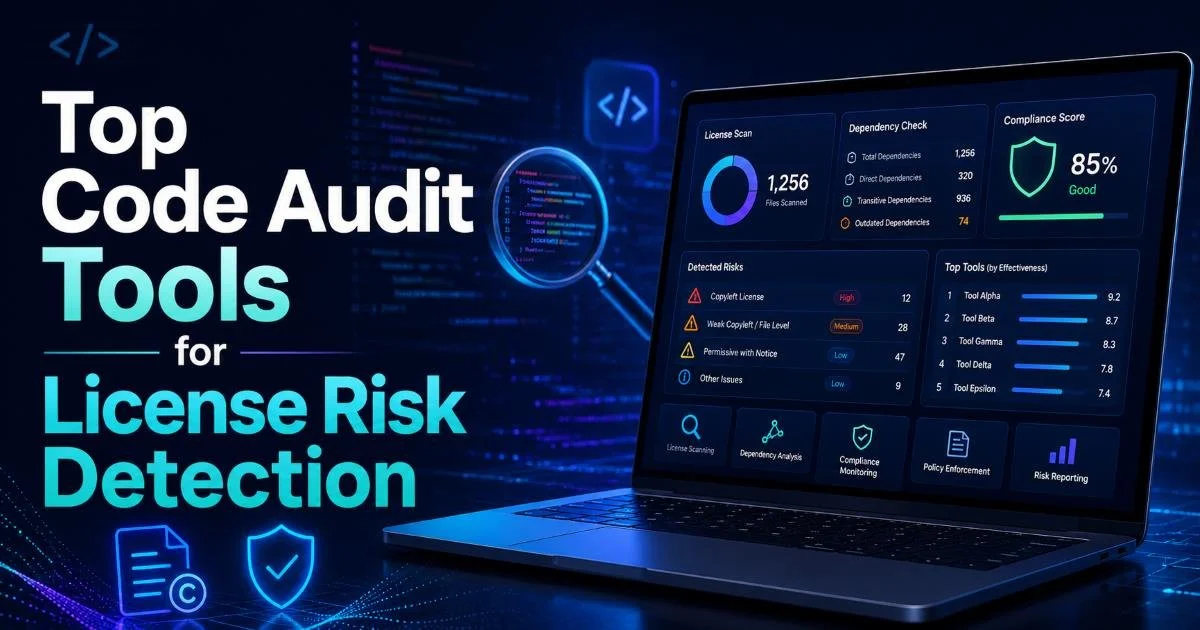
Code audit tools for license risk detection have become a non-negotiable part of modern software development. Every application you ship likely contains dozens, sometimes hundreds, of open source dependencies. Each one carries a license, and each license carries obligations that can range from simple attribution to full source code disclosure.
Miss a copyleft requirement buried three layers deep in your dependency tree, and you're facing legal exposure that no amount of post-release patching can fix. Engineering teams need systematic, automated approaches to identify these risks before they compound.
The good news is that a growing ecosystem of AI-powered and traditional scanning tools now makes AI code and license auditing accessible to teams of any size. This guide walks you through the practical steps to select, configure, and operationalize the right tools for your stack.
Key Takeaways
- Automated license scanners catch risks that manual code reviews consistently miss in complex dependency trees.
- Integrate license checking into your CI/CD pipeline to block non-compliant code before it ships.
- Combine SBOM generation with license analysis for complete visibility into your software supply chain.
- AI-powered tools identify license conflicts faster by analyzing code snippets, not just package metadata.
- Establish a written license policy first so your tooling has clear rules to enforce automatically.
1. Understand the License Risk Landscape Before Choosing Tools
Before you evaluate any software license checker, you need a clear picture of what you're defending against. License risk isn't a single category. It spans copyleft obligations (GPL, AGPL) that can force source disclosure, permissive licenses (MIT, Apache 2.0) with attribution requirements, and restrictive or custom licenses that may prohibit commercial use entirely. A 2023 Synopsys audit found that 84% of codebases contained at least one open source vulnerability, and 53% contained license conflicts. These numbers aren't theoretical; they represent real exposure in production software.
The complexity multiplies when you consider transitive dependencies. Your application might directly import 40 packages, but those packages pull in 400 more. Each transitive dependency carries its own license, and those licenses can conflict with each other or with your project's distribution model. A single AGPL-licensed utility buried four levels deep in your Node.js dependency tree can change the legal obligations for your entire product. Understanding this is foundational to avoiding the legal pitfalls of open source compliance.
Why Metadata Alone Fails
Many teams assume that checking the "license" field in a package.json or pom.xml file is sufficient. It isn't. Package metadata is frequently inaccurate, incomplete, or missing entirely. A package might declare MIT in its metadata while containing files with GPL headers, or it might include vendored code with an entirely different license. This is exactly why software license checkers that detect hidden risks perform file-level scanning rather than relying on declared metadata alone. Real license risk detection requires inspecting actual source files.
Never rely solely on package registry metadata for license information. File-level scanning is mandatory for accurate detection.
Snippet-level detection adds another layer of complexity. Developers copy code from Stack Overflow, GitHub Gists, and blog tutorials constantly. That copied code carries the license of its source, even if no one documents it. AI-based code audit tools can fingerprint these snippets and trace their origins, flagging license obligations that purely dependency-based scanners would never catch. This capability separates modern detection tools from their predecessors.
2. Evaluate the Top Code Audit Tools for License Detection
The market for license risk detection tools ranges from free, open source scanners to enterprise platforms costing six figures annually. Your choice depends on your team size, the languages you use, your deployment model, and how deeply you need to integrate scanning into your workflow. The most effective approach for most engineering teams is a layered strategy: a fast, lightweight scanner in CI/CD paired with a deeper analysis tool for release milestones and M&A due diligence scenarios.
Tool Comparison Matrix
FOSSA and Snyk dominate among mid-size engineering teams because they offer generous free tiers and solid API integrations. FOSSA excels at deep license analysis with policy-as-code capabilities. Snyk is stronger on vulnerability detection but has steadily improved its license compliance features. For enterprise use, Black Duck remains the industry standard, particularly for M&A audits where the thoroughness of its knowledge base justifies the premium pricing.
Open source options deserve serious consideration. ScanCode Toolkit, maintained by nexB, performs rigorous file-level license detection and supports over 30 package formats. FOSSology, backed by the Linux Foundation, provides a web-based interface for collaborative license review. The OSS Review Toolkit (ORT) offers an end-to-end pipeline from dependency analysis through to reporting. These tools require more configuration effort but give you full control over your scanning infrastructure.
Start with ScanCode Toolkit for a zero-cost proof of concept, then evaluate commercial tools against its detection accuracy as your baseline.
AI-powered tools are the newest entrant in this space. They go beyond pattern matching to understand code semantics, identifying license obligations in refactored or modified snippets that rule-based scanners miss. Some platforms use machine learning models trained on millions of open source repositories to detect code provenance with high confidence. This capability is particularly valuable for teams working with legacy codebases where the origin of specific code blocks is undocumented.
3. Integrate License Detection Tools Into Your Development Workflow
CI/CD Integration
The most impactful decision you'll make isn't which tool to buy; it's where you place it in your pipeline. License scanning should run on every pull request, not just on release branches. This catches problems when they're cheapest to fix: before the code is merged. Configure your scanner to fail the build when it detects a blacklisted license (AGPL, SSPL, or whatever your policy prohibits). This prevents non-compliant dependencies from ever reaching your main branch.
Most commercial tools provide GitHub Actions, GitLab CI templates, or Jenkins plugins that take minutes to configure. For ScanCode Toolkit, you'll write a small shell script that runs the scan and parses the JSON output against your policy file. The typical scan time for a medium-sized project (500 direct dependencies) is two to five minutes, which is fast enough for PR-level gating. Cache your dependency resolution step to avoid redundant network calls on repeated scans within the same pipeline run.
Set your CI scanner to "warn" mode during initial rollout so developers can see violations without blocked merges. Switch to "fail" mode after two weeks.
Developer IDE Integration
Shifting license awareness even further left means bringing it into the IDE. FOSSA offers a VS Code extension that flags license issues as you add dependencies. Snyk's IDE plugins cover VS Code, IntelliJ, and Eclipse. For teams debating their IDE choice between Visual Studio Code and PyCharm, both editors support license scanning extensions from major vendors. This immediate feedback loop means developers learn about problematic licenses before they even commit code.
Pre-commit hooks offer another lightweight integration point. A simple hook that runs a license check against your lockfile before allowing a commit adds almost no friction. The key is making the feedback fast and actionable. Show the developer exactly which dependency triggered the violation, what license it carries, and what alternatives exist. Vague "license violation detected" messages breed frustration and hook-skipping behavior among developers who are trying to ship features.
"The best license detection happens before code reaches the pull request, not after it ships to production."
4. Operationalize Ongoing License Compliance and Monitoring
Building Your Policy Engine
Tools without policies are just noise generators. Before you turn on automated scanning, build an open source license policy that defines three categories: approved licenses, restricted licenses (requiring legal review), and prohibited licenses. This policy should be a machine-readable file (YAML or JSON) that your scanning tools consume directly. FOSSA, ORT, and Black Duck all support policy-as-code configurations that turn your legal decisions into automated enforcement.
Your policy should account for context. A GPL-licensed library might be acceptable in an internal tool that's never distributed but prohibited in a commercial SaaS product. Configure your scanner with project-level policy overrides so the same tool can enforce different rules across different repositories. This prevents the common failure mode where teams adopt a one-size-fits-all policy that's either too restrictive (blocking legitimate dependencies) or too permissive (missing real risks).
SBOM (Software Bill of Materials) generation is the output that ties everything together. Every major scanning tool can produce SPDX or CycloneDX format SBOMs. These machine-readable documents list every component, its version, and its license. Regulatory frameworks like the EU Cyber Resilience Act and US Executive Order 14028 are making SBOMs a requirement, not a nice-to-have. Generate them automatically on every release and store them alongside your build artifacts for audit readiness.
Ongoing monitoring matters because licenses change. A package maintainer can relicense from MIT to AGPL between minor versions. Your scanning tool should alert you when a dependency's license changes, even if no code in your repository changed. Both FOSSA and Snyk offer continuous monitoring that watches your dependency graph and notifies you of new license changes or conflicts. Set up weekly digest emails to your engineering leads so license drift doesn't go unnoticed between active development cycles.
Schedule a quarterly license audit review meeting with engineering and legal to update your policy based on new dependencies and business context changes.
Frequently Asked Questions
?How do I catch AGPL licenses hiding in transitive dependencies?
?Is scanning package metadata enough, or do I need full code scanning?
?How long does it take to integrate a license checker into a CI/CD pipeline?
?Can AI-powered scanners handle code where no license is declared at all?
Final Thoughts
Effective license risk detection isn't about picking the most expensive tool or the one with the longest feature list. It's about choosing tools that match your workflow, configuring them with clear policies, and positioning them where they catch problems early.
Start with a policy document, integrate a scanner into your CI pipeline, and expand to IDE-level and continuous monitoring as your program matures. The teams that treat open source compliance as an engineering problem, not just a legal checkbox, are the ones that ship confidently without surprises at audit time.
Disclaimer: Portions of this content may have been generated using AI tools to enhance clarity and brevity. While reviewed by a human, independent verification is encouraged.